Glossar-English:Figure/Ground Differentiation
Sub-Item to: Image Perception
Original: Figur/Grund-Differenzierung
|
The juxtaposition of »figure« and »ground« is a very general principle of perception, which has been recognized and examined primarily based on image perception and is also of particular importance for this: In every case of perception, the field of perception is necessary divided into a focused area called a ‘figure’, which is perceived as emerging from the background of the rest of the field of perception. This classification distinguishes perception from related but structurally simpler notions of the impact of the world on an organism's activities. For example, the reflex concept does not yet contain a figure/ground differentiation of the stimulus: The stimulus associated with a reflex arc is either present or not – its situational embedding in the context is not of importance for the reflex.[1] Only in the case of percepts assigned to more complex behavior[2] does it make sense to speak of an area that stands out from the whole “Merkfeld” (field of noticing), whose effect depends at the same time on the rest of the Merkfeld. It does not matter whether the figure is the visual shape of a seen, partially hidden object, a voice in polyphonic musical composition, the olfactory component of a perfume, or the taste of a certain spice in a dish: this figure always exists only in front of (or: embedded in) an associated ground.
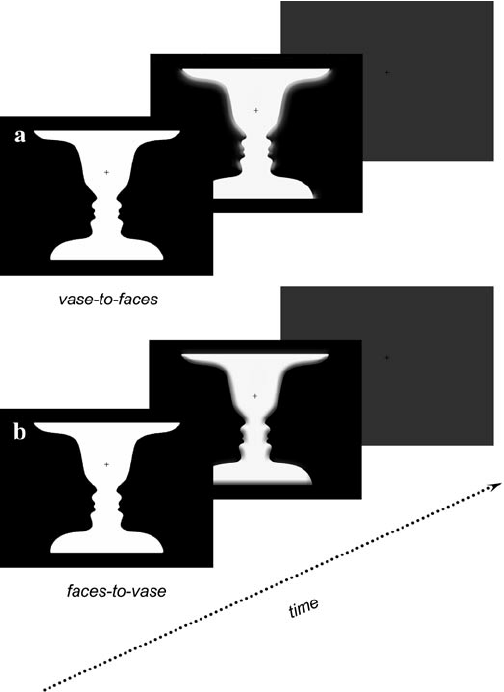
Anchoring in Gestalt theoryIn order to organize the abundance of information that a living being receives from its environment and to use it for its behavior, selecting and grouping factors must work together. Essential factors that play a role specifically in the phenomena called 'perception' have been compiled in Gestalt theory. What is perceived are not isolated elements – individual sensations (such as would correspond to the excitation state of a single visual cell) – but totalities, which are, in principle, something that can occur embedded in different environments. Thus, such totalities appear in principle as figures in front of a background and focus in this way attention to certain recurring configurations.  The figure/ground differentiation provides the framework for the Gestalt psychological grouping rules: Gestalt laws, such as the law of proximity, closure, or continuity, aim to distinguish parts of the field of vision as one figure from the rest. For example, the graphically non-existent “white triangle on a white background” in Figure 1 is seen as a “good Gestalt” against a background that is essentially the same color. As a general perceptual phenomenon, figure/ground differentiation is not specifically limited to visual perception, let alone the perception of images. However, the phenomenon was mainly discovered and investigated based on particular image perceptions. Discovery by RubinThe figure/ground “illusion” was introduced to science around 1915 by the Danish psychologist Edgar John Rubin (1886–1951), mainly using the example of the “Rubin's Vase”, as it is called (cf. Fig. 2). This graphic, in which the perception of two faces facing each other switches to the perception of a vase standing in between, plays a vital role for the first time in Rubin's two-volume work «Synsoplevede Figurer» ("Visually perceived figures").[3] Rubin's graphic is a special case of the so-called multistable perception.[4]  Rubin, who comes from Copenhagen, spent some time in Göttingen, to which, among other things, a phenomenological perspective in his conception of visual perception can be traced back. However, his proximity to Gestalt psychology is even more obvious insofar as the “Rubin Vase” provided further evidence for their thesis that what is visually perceived is not identical to the retinal image. The principle of emergence, according to which we perceive objects in our environment as a whole and all at once, can be made clear in «Rubin's Vase». Therefore, perception should be understood as a productive process of object constitution, which provides what is grasped in our experience with content about the position and nature of the respective objects – content not already contained in the pure sensory data. What does «figure and ground» mean?Based on “Rubin's Vase”, it is possible to examine the laws according to which figure and ground are formed in perception and how one jumps back and forth between different figure/ground differentiations. In 1915, Rubin formulated the following “fundamental proposition”:
In the case of bistable perception, this “formative effect” manifests itself to the same extent on both sides: The assignment of figure and ground is interchangeable and fluctuates spontaneously. In Rubin’s famous example, we see two faces against a white background and a vase against a black background. At any given point in time, we only perceive one of the two possibilities. Since the excitation pattern of the retina did not change, it cannot be used as a cause for the spontaneous change in assignment. As Rubin has noted, we tend to think of a smaller, closed shape as a figure against the ground of the larger surrounding area.[5] The figure has a thing quality, while the ground seems rather difficult to grasp and categorize. The figure stands out; the ground takes a back seat. In particular, the contour separating them is always attributed to the figure, not the ground. Recent psychological experiments have empirically confirmed Rubin's thesis regarding the contour ([Andrews et.al. 2002a]Andrews, Timothy J.; Schluppeck, Denis; Homfray, Dave; Matthews, Paul & Blakemore, Colin (2002): Activity in the Fusiform Gyrus Predicts Conscious Perception of Rubin’s Vase—Face Illusion. NeuroImage, 17. Link to visual depth perception The fact that the contour line belongs to the figure and marks its boundary also means that the ground is perceived as continuing behind the figure, although it cannot be seen directly there. The contour line does not act as a boundary for the ground. The variant of Rubin's vase shown in Figure 3 – which in this case is actually not a vase but a candlestick – demonstrates this aspect conspicuously: In addition to the two figure assignments of the classic version – two faces opposite each other in profile or a candlestick – appears here as a third variant: a frontal face on both sides of the candlestick, which remains partially hidden behind it (and itself appears against another background with a hexagonal pattern). Arnheim sees the figure/ground differentiation as a particular case of creating depth gradations in visual perception, namely one with precisely two levels ([Arnheim 2000a]Arnheim, Rudolf (2000): Kunst und Sehen: Eine Psychologie des schöpferischen Auges. DeGruyter, Berlin, New York. However, in contrast to the figure/ground differentiation, the general depth gradation cannot be readily transferred to other sensory modalities: While a generalization of the figure/ground differentiation graded according to distance may still make sense in the sense of hearing, the other senses seem to be more reluctant to do so: As local senses, they do not provide an overview. A dynamic in the figure/ground differentiation caused by occlusions must be conceived quite differently here. Incidentally, in terms of action theory, a connection can be made between the specific type of figure/ground differentiation in visual perception and the ability to change the focus area of the lens in the eye – a behavioral option not available in the other distance senses. Together with the corresponding eye orientation (i.e., more (closer) or less (further) deviating from the parallelism of the optical axes of the eyes), this effector part of the visual perception apparatus forms the basis for the coupling of figure/ground differentiation with depth perception.[7]
Two types of dynamics of figure/ground differentiationsFigure/ground differentiations are not a static phenomenon: The division of what is perceived into figure and ground, which constitutes perception, changes over time, even if there is no change in the external world (the underlying stimulus situation). This dynamic can simply correspond to the temporal sequence in which different areas of the respective field of noticing come to the fore of perception. However, it can also be about a completely different kind of displacement of ground and figure, in which something initially a (holistic) figure can now itself be subjected to (various) figure/ground differentiations. For the sake of simplification, dynamics of the first type can be described as 'horizontal', especially since the horizon of observation is not changed, so the perception, metaphorically speaking, “remains within the same horizon”. With the second type, on the other hand, the horizon of perception changes, as with a vertical movement or a zoom; hence the metaphorical short designation ‘vertical dynamics’. The “horizontal” dynamics Bistable perceptions, such as in «Rubin's Vase», in which the allocation of figure and ground spontaneously reverses itself again and again, actually represent only a particular case of a general variability of the figure/ground formation. The change of the concrete figure/ground differentiation can – but does not have to, as the spontaneous changes in multistable perceptions make clear – be influenced by the perceiver through shifts of attention. For example, a viewer of the image in Figure 4 will – depending on his eye movements – jump back and forth between different figure/ground associations.[8] Various areas of the image are each used as a figure in front of the rest as the ground: These changes are for sortal objects apparent[9] but by no means limited to these. Even if, for example, the brushstrokes of a painting are observed, and the attention shifts from one particularly executed brushstroke to an adjacent stroke, this is always accompanied by a corresponding new figure/ground differentiation of the visual field of perception: What originally was part of the ground becomes the new figure, and the old figure transforms to part of the new ground. Quite analogously, a switching of the figure/ground distinction in hearing is the perceptual basis of the change of attention to another voice in polyphonic composition or even to another instrumental group in the overall sound of a sustained orchestral chord; in smelling, the emergence of another olfactory component of a perfume, or in tasting, the noticing of another ingredient in a sauce. The “vertical” dynamicsIn Figure 4, consider the shuttlecock. Now, look at the white spot in the area of the image that represents the red cap of the shuttlecock. In both cases, your perception is accompanied by a corresponding figure/ground differentiation. However, what initially was the figure is now broken down into figure and ground. Although the transition between the two looks at first like a case of “horizontal” figure/ground dynamics, it is a much more complex phenomenon related to the question of what it actually is that is changing (“horizontally”) into different figure/ground pairings. In particular, constructivist theories of perception distinguish between what is already separated into figure and ground (“this is how we see the world”) and what can be broken down – by an observer – into (in principle diverse) figure/ground differentiations, but itself is not yet so fragmented (“the world that can be seen”, “that which is perceived (employing figure/ground differentiations made upon it)”). In addition to the actual figure/ground structure, there is a third element which, following Heider's thought, can be called the ‘medium’ of the figure/ground differentiation.[10] Characteristic of this “vertical” dynamic of figure/ground differentiation is that the medium for a figure/ground differentiation itself represents the result of another (“deeper”) figure/ground differentiation. In particular, the phenomenon of the third dimension emerging is connected with it.  That can be made explicit using the example of the so-called Necker cube. The Necker cube is considered a typical example of bistable 3D perception: In the figure of a cube defined by the black lines in front of a neutral background, either the upper left or the lower right of the two corners seen inside the figure is in front. Both perceptual alternatives exclude each other and usually jump spontaneously into each other. However, there is another way of looking at the image in 2D interpretation – flat black lines on a white surface that form a surface tiling. In this case, it is not the cube that forms the figure, but one of the following surfaces: a small square in the middle, surrounded by two opposite small triangles (bottom left and top right), and four trapezoids. Think of the graphic as part of a floor designed with white tiles and black grout. Obviously, this perception corresponds to the perception of the image carrier, from which the third dimension in which the cube exists is derived.  The “aha” effect – characteristic of emergence phenomena – that usually occurs only after some time during the first encounter with the pigment distribution in Figure 6 also corresponds to a change in the figure/ground assignment in the vertical sense: While at first, the black spots appear as more or less randomly distributed on the surface and individual ones of them spontaneously emerge as a figure in front of the surrounding surface, in a favorable case, perception organizes itself after some time in such a way that in particular a sniffing Dalmatian is seen as a figure in front of a street scene in the center of the image. As with the Necker cube, it is difficult to return to the underlying surface view once the three-dimensional scenic view has appeared. The descent to the intrinsic value elements of the image syntax is seldom spontaneous. However, it is precisely this reversal of the vertical figure/ground shifts that plays a vital role in artistic vision, as it is often called, since it is about eliminating the prevailing figure/ground differentiations and, for example, seeing the two-dimensional surface division of the picture instead of the Necker cube. Also, the reflexive use of images (or scenes) refers to the vertical dimension insofar as the image perceptions are used here as examples for certain figure/ground differentiations or their lack: The image of Rubin's vase is not usually employed to represent two faces (or one vase) visually, but rather to demonstrate the phenomenon of bistability in figure/ground differentiation and thus a particular type of figure/ground dynamics as a figure itself. The vertical shifts in figure/ground differentiation are not limited to the visual senses either. An auditory example might be the difference between following a melody and concentrating on the intonation of its execution.
ImpactsImpacts concerning image and image perceptionAs a general characteristic of perception, the figure/ground differentiation is not specific to image perception, but it is also very important there, especially in the case of figurative images. Accordingly, «Rubin's Vase» had an impact on the fields of art and design. Figure/ground effects, which are analogous to the switching image of faces and vase, were often used at a very central point by MC Escher, for instance.[11]. Switching images in general, however, are not specific to Rubin's discovery. Many logo designers use ambiguity regarding figure/ground differentiation to gain increased attention. In art, by the way, instead of ‘figure’ and ‘ground’ one often speaks of ‘positive’ and ‘negative space’, respectively (cf. [Tritthart 2013a]Tritthart, Martina (2013): Der negative Raum oder die andere Seite des Lichts. Maria Nordman und Nan Hoover: Wahrnehmung Raum Kunst Architektur. ALL-OVER. Magazin für Kunst und Ästhetik, 5. Regarding the constitution of the image content, especially in naturalistically designed images, photographs, or projections, the figure/ground distinctions that are effective here are more or less directly comparable with the “direct” visual perception of the scene presented. Conversely, for example, weakening of the figure-forming properties of an outline in Asian graphics as well as in classical modernism in the West are used to undermine the naturalistic depth gradation and three-dimensional spatial effect. Looking at line drawings by Matisse (opposite Rembrandt), Arnheim explains:
In general, specific styles of representation, primarily through contour emphasis, light-shadow setting, and similar “techniques”, make it possible in pictures, as intentionally designed perceptual offers, to force certain figure/ground formations in the viewer and thus to induce targeted interpretations. In this manner, the probability of success of the intended communication can be increased: The conscious design of the figure/ground differentiation thus acts as a communicative strategy. In this respect, creating multistable visual perceptions represents a special case of image production. Moreover, central to image perception is the figure/ground differentiation for the perception of the image as a whole, namely as an image carrier against its background. No matter how much the perception of the depicted may be based on the figure/ground differentiations made possible by the depicted scene itself, for instance, in the case of a trompe l'œil, this alone would not constitute a picture, but would merely describe a perceptual illusion (⊳ Deceptive and immersive mode and perceptual illusion). By using a frame, the picture area is delimited from the surrounding wall area and emphasized as a figure. Correspondingly, the frame (as a particularly emphasized contour) is also counted as part of the picture carrier, behind which the wall continues unseen. Within the image carrier, on a second level of figure/ground differentiation, the frame can be seen as a figure in front of the background of the image space (in the case of three-dimensional images)[13], which is mostly conceived of as continuing behind the frame – e.g., in the sense of Alberti's window.[14] Only on a third level can the image-relevant figure/ground differentiations be formed within the image space (or the image surface in the narrower sense), which serve to perceive the actual content of the image. The frame lies entirely outside the perceptual space considered, which is essentially felt to be inherently unlimited. Image perception is thus based, at least in the case of figurative images with a pronounced frame, on at least a double cascade of vertical shifts of figure/ground differentiations, through which the conflicting situatednesses of both image content and wall are constituted as simultaneously located behind the frame. Reference has already been made above to the role of figure/ground differentiation in creative seeing and the reflective use of images. Associations in communication theoryThe conception of the figure/ground differentiation is not only relevant in theories of perception: An analogous differentiation can also be stated in communication and especially in the use of verbal signs. Thus, in linguistics, those parts of an utterance or sentence are characterized as »thematic« or »topic« which are already known to the addressee (or at least considered known to them); what is new for them comes up in the sections judged as »rhematic« (or »comment«). The theme forms the background for the actually important communication of the rheme, which would not be understandable without this anchoring in what is already (commonly) known.[15] Strictly speaking, propositional utterances even conceal a double figure/ground division: On the one hand, the differentiation between the thematic context and the focused propositional content of the utterance; and on the other hand, within the proposition, the differentiation between the nominations, which serve as an anchor as the already known background (and part of the context) of the new information, and the predication, which appears as a figure (and as such should not yet be included in the joint discourse context prior to the utterance).[16] In the field of communications technology, i.e., in the engineering sciences, the relation between »signal« and »noise« (also »underground«) plays a role comparable to »figure« and »ground«. In contrast to the usual way of speaking of the figure before the ground, however, it is said here that it is the signal that is superimposed by the noise.[17] Figure/ground differentiation and attentionEvidently, the figure/ground differentiation can be influenced and controlled within certain limits by attention and expectation. The Gestalt-forming processes that separate the figure from the ground represent a spontaneously effective attention mechanism. In contrast to attention phenomena in the narrower sense, however, the figure/ground differentiation does not mask the respective background. For example, if a task is being worked on with great concentration – or even a game is played completely immersed – the respective environment is often entirely “forgotten”. It remains subjectively vanished. The interplay between spontaneously formed figure attention and expectation-driven concentration on certain stimulus constellations is particularly evident in the reverse vertical dynamics mentioned above: It is difficult to assert the creative perspective against the spontaneous three-dimensional formation of Gestalts, even if this is bistable. In digital image processing, an analogous distinction is made between so-called bottom-up processes and top-down processes: In bottom-up processes, sensory elements are selected and grouped together according to Gestalt laws – so to speak, without attention control – and tied together to form more complex perceptual units; in top-down procedures, the grouping and selection steps are guided by a given target Gestalt (on which, as it were, attention is focused). The target can also be a 3D model (⊳ Computer graphics) or even correspond to a sortal object. See also:
|
Notes
Literature
[Andrews et.al. 2002a]Andrews, Timothy J.; Schluppeck, Denis; Homfray, Dave; Matthews, Paul & Blakemore, Colin (2002): Activity in the Fusiform Gyrus Predicts Conscious Perception of Rubin’s Vase—Face Illusion. NeuroImage, 17.[Arnheim 2000a]Arnheim, Rudolf (2000): Kunst und Sehen: Eine Psychologie des schöpferischen Auges. DeGruyter, Berlin, New York.[Gallistel 1980a]Gallistel, Randy (1980): The Organization of Action: A New Synthesis. Lawrence Erlbaum Assoc., Hillsdale, NJ.[Heider 1926a]Heider, Fritz (1926): Ding und Medium. Kulturverlag Kadmos, Berlin.[Mathesius 1911a]Mathesius, Vilém (1982): O potenciálnosti jevů jazykových (Über die Potentialität der Spracherscheinungen) (1911). In: Vachek, J. & Macek, E. (Hg.), V. Mathesius: Jazyk, kultura a slovesnost. Odeon, Prag.[Rubin 1921a]Rubin, Edgar (1921): Visuell wahrgenommene Figuren. Studien in psychologischer Analyse. Gyldendalske Boghandel, Kopenhagen.[Sherrington 1947a]Sherrington, Charles S. (1947): The Integrative Action of the Nervous System. Yale Univ. Press, New Haven.[Tritthart 2013a]Tritthart, Martina (2013): Der negative Raum oder die andere Seite des Lichts. Maria Nordman und Nan Hoover: Wahrnehmung Raum Kunst Architektur. ALL-OVER. Magazin für Kunst und Ästhetik, 5.[Velden 1982a]Velden, Manfred (1982): Die Signalentdeckungstheorie in der Psychologie. Kohlhammer, Stuttgart. Version 1: 2016 Responsible: Lektorat: Contributions by: Joerg R.J. Schirra und Marcel Lemmes — (Note) Quote as: |